We need Universal Basic Services, not Universal Basic Income
It's a controversial topic

This is a extract from Chapter 21 - A New Social Contract - of my forthcoming book The Economics of Kindness: The End of Capitalism, the Birth of a New Ecological Civilization (Palgrave Macmillan, Spring 2026).
A huge task remains: to reduce the staggering inequality that has arisen over the last 40 years, and reduce the poverty, resentment, anger, debt, and breakdown of trust it has caused. To understand the searing realities of poverty, I recommend a day with Matthew Desmond’s Poverty, by America, or Danny Dorling’s Shattered Nation, about Britain.
In the early 1970s Britain had the lowest inequality in Europe, similar to Finland and Norway, along with the highest life expectancy and the lowest infant mortality in the world. By 2022, after forty years of the neoliberal political order, Britain had risen right to the top of the inequality list, below only Bulgaria and Lithuania.
We need to end this. We need a new social contract that will reduce inequality, enable everyone to meet their basic needs, and offer everyone – meaning everyone – dignity, and the potential to enjoy a purposeful life. In America, it has been framed as ‘An Economic Bill of Rights for the 21st Century’ and as ‘The Guarantee’, as Natalie Foster describes it in The Guarantee: Inside the Fight for America’s Next Economy.
A new social contract needs to offer ten things to every citizen. The first four are affordable housing; fair work with a living wage and workplace benefits; free public healthcare; and free college education. This chapter focuses on the next five: universal basic services; a guaranteed income; a social wealth fund, debt resolution; and social inheritance bonds. The tenth - fair taxation – is covered in Chapter 22.
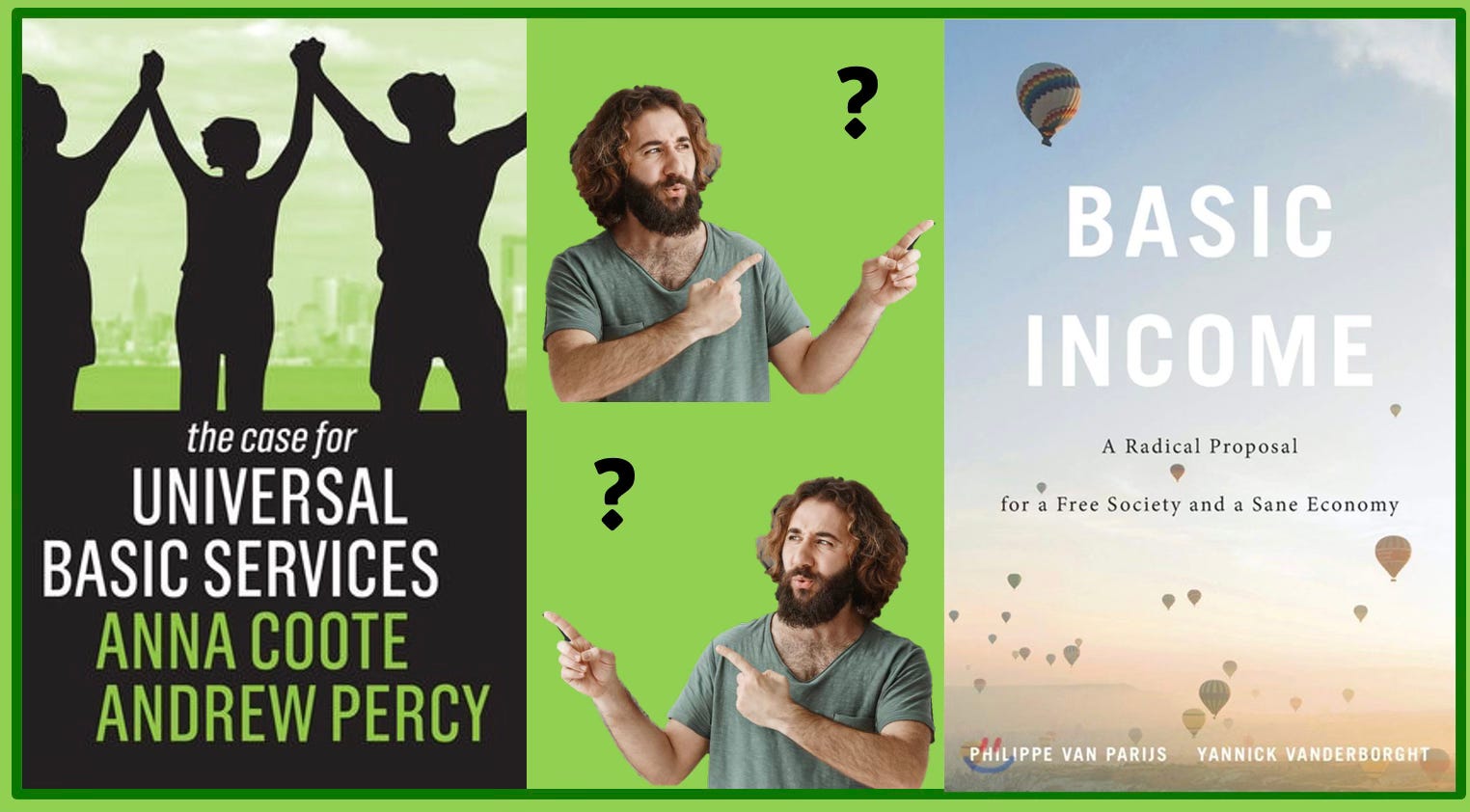
Many people assume Universal Basic Income to be a good thing, but the British authors Anna Coote and Andrew Percy have found no evidence that it can live up to the more ambitious claims made for it. They argue that it makes more sense to invest in Universal Basic Services, including free or subsidized childcare and adult social care, affordable housing, affordable transportation, and affordable broadband digital services.[i]
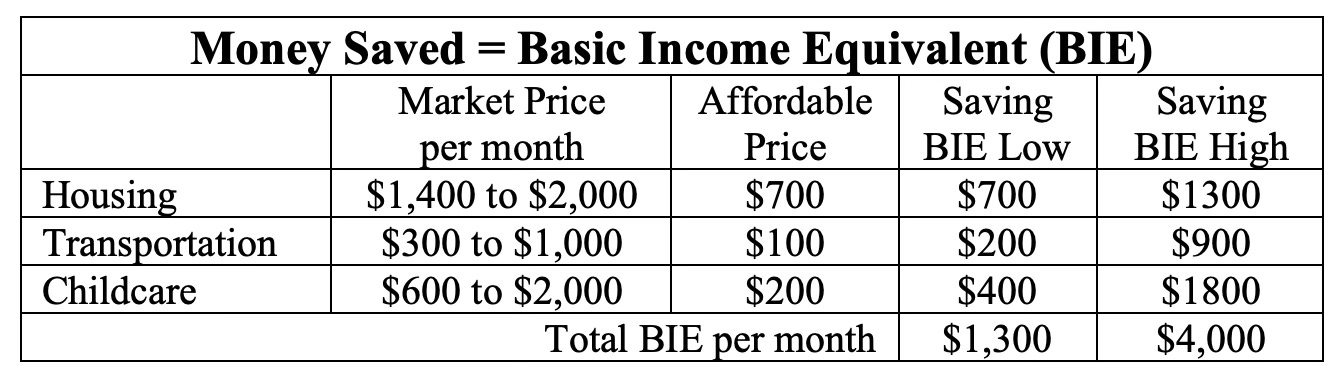
If the rent for a person on a low income can be held at $700 a month, rather than $1,400, that’s a saving or Basic Income Equivalent (BIE) of $700 a month.
Owning a car costs between $3,600 and $12,000 a year, but if a community has affordable transit, safe cycling routes, good walking trails, and a car-sharing coop, so that you don’t need a car, that’s a saving of $300 to $1,000 a month.
Childcare costs between $600 and $2,000 a month, but only $200 when it’s $10 a day, which is the goal for all of Canada by 2026.[ii]
If it’s free, as it may be soon in New York, that’s even better.
Combined, the saving for just these three items comes to between $1,300 and $4,000 a month.
There’s no doubt that Universal Basic Income would reduce poverty, anxiety, and financial fear, and improve physical and mental wellbeing, just as Basic Income would. If everyone got Basic Income, however,
Landlords would feel more able to increase their rents.
Employers would feel less need to pay fair wages,
Unions would feel less need to fight for higher wages,
Childcare providers would feel free to raise their rates.
The money would end up in the pockets of others, leading to calls for it to be increased. The cycle would then be repeated, yet once implemented, Basic Income would be very hard to take away. It would increase individualization, increase loneliness, and enable continued neoliberalism. Universal Basic Services, by contrast, would strengthen mutual solidarity, trust, and community wealth.
At first, I was persuaded by Basic Income champions like Rutger Bregman and Guy Standing,[iii] but now I think Universal Basic Services makes more sense. We need an informed debate, rather than the assumption that Basic Income will work without considering its wider economic impacts, and the alternative.[iv]
Universal Basic Services would bring many co-benefits. Guaranteed affordable housing would remove stress and fear. Investments in transit, cycling, and walking would create greener towns and cities. $10 a day childcare would enable all children to benefit. The monthly BIE would reduce poverty, reduce debt, and reduce inequality.
Targeted Basic Income is different. Giving it to people in special circumstances makes total sense, including people who are stuck in lockdown during a pandemic, people who have just left prison,[v] and youths who are aging out of care, many of whom become homeless.
In 2022, Wales started a targeted scheme for 18-year-olds who were leaving care, giving them £1,600 a month for two years.[vi]
In California, the HOPE Fund gives $4,500 to every child who lost a parent to Covid, and every kid in foster care, reaching 58,000 children.[vii]
In a healthy democracy, a new social contract could be enacted by a political majority. In America, it would need a progressive President, progressive majorities in Congress and the Senate, and a Supreme Court whose members would not use the imagined principles of eighteenth-century justice to declare it unconstitutional. It will probably generate splutters of outrage from the wealthy, but it is definitely doable.
A new social contract that is fair, inclusive, and leaves no-one behind. Mamma mia, do we need it.
[i] Coote, Anna, and Andrew Percy. The Case for Universal Basic Services. Polity, 2020
[ii] “Demanding Change: Repairing our Childcare System.” Childcare Aware of America
“Toward $10-a-day: Early Learning and Child Care.” Government of Canada, March 24, 2025
Buller, Robin. “How did childcare in the US become so absurdly expensive?” Guardian, March 24, 2025
[iii] Bregman, Rutger. Utopia for Realists: How We Can Build the Ideal World. Bay Back Books, 2018
Van Parijs, Philippe, and Yannick Vanderborght. Basic Income: A Radical Proposal for a Free Society and a Sane Economy. Harvard University Press, 2019. See also “Basic Income Lab.” Stanford Basic Income Lab.
[iv] Coote, Anna, and Edanur Yazici. “Universal Basic Income – a Union Perspective.” New Economics Foundation, April 2019
[v] McDonough, Siobhan. “A bold new experiment out of Florida: Guaranteed income for the formerly incarcerated.” Vox, Feb 3, 2023
[vi] “Basic income: Wales pilot offers £1,600 a month to care leavers.” BBC, Feb 16, 2022
[vii] “California HOPE for Children Trust Account Program.” California Hope for Children, Feb 1, 2024